The View From Opoutere
Useful information about the Opoutere area brought to you by the Opoutere Ratepayers and Residents Association.

Thriving In Isolation #4
It’s Easter…but not as we know it.

This time last year Opoutere was jumping – boats putted about the harbour, the beach was busy, the carpark was packed with freedom campers and the supermarket was thronging with locals and visitors all clamouring for last-minute supplies.
2020 finds Opoutere so quiet it’s perfectly normal to see white-faced herons strolling down the middle of the road.
This year there are police checkpoints around the Coromandel turning away people heading to their holiday homes and locals are keeping an eye on empty properties to make sure there are no surprise arrivals midway through the national lockdown.
Thames Coromandel District Council have sent out multiple emails imploring people to stay in isolation and not attempt a late-night dash to their bach. It increases the risk of community spread and threatens the capacity of local health services. The message is clear – wherever you started the lockdown is where you should stay until it’s over.
How are your emotions treating you?
TCDC’s Civil Defence Controller Garry Towler explains the various stages of human response during a crisis event like the one we are all in at the moment.
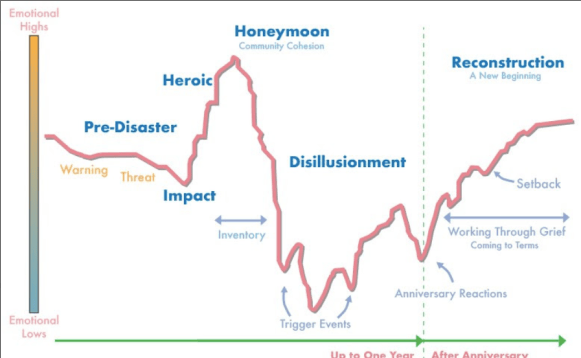
“The graph (above) is an internationally acclaimed picture of what happens to us before, during and after a disaster,” says our Civil Defence Controller Garry Towler. “While modelled on crises such as 9-11, major cyclones, tsunamis and earthquakes, it is very relevant for us today in the COVID-19 emergency as it has a wide impact on all of us.”
See the section below “Phases of a disaster”, for the full explanation.
“Right now, we’re in the honeymoon phase and over the next few weeks we’ll be heading into the disillusionment phase, the most important phase in terms of how we look after ourselves, families and friends,” says Mr Towler.
Phases of a disaster
Phase 1: The pre-disaster phase –characterised by fear and uncertainty. The specific reactions a community experiences depend on the type of disaster. Disasters with no warning can cause feelings of vulnerability and lack of security; fears of future, unpredicted tragedies; and a sense of loss of control or the loss of the ability to protect yourself and your family. On the other hand, disasters with warning can cause guilt or self-blame for failure to heed the warnings. The pre-disaster phase may be as short as hours, or even minutes, such as during a terrorist attack, or it may be as long as several months, such as during a hurricane season.
Phase 2: Impact phase – characterised by a range of intense emotional reactions. As with the pre-disaster phase, the specific reactions also depend on the type of disaster that is occurring. Slow, low-threat disasters have psychological effects that are different from those of rapid, dangerous disasters. As a result, these reactions can range from shock to overt panic. Initial confusion and disbelief typically are followed by a focus on self-preservation and family protection. The impact phase is usually the shortest of the six phases of disaster.
Phase 3: Heroic phase – characterised by a high level of activity with a low level of productivity. During this phase, there is a sense of altruism, and many community members exhibit adrenaline-induced rescue behaviour. As a result, risk assessment may be impaired. The heroic phase often passes quickly into phase 4.
Phase 4: Honeymoon phase – characterised by a dramatic shift in emotion. During the honeymoon phase, disaster assistance is readily available. Community bonding occurs. Optimism exists that everything will return to normal quickly. As a result, numerous opportunities are available for providers and organisations to establish and build rapport with affected people and groups, and for them to build relationships with stakeholders. The honeymoon phase typically lasts only a few weeks.
Phase 5: Disillusionment phase – is a stark contrast to the honeymoon phase. During the disillusionment phase, communities and individuals realise the limits of disaster assistance. As optimism turns to discouragement and stress continues to take a toll, negative reactions, such as physical exhaustion or substance use, may begin to surface. The increasing gap between need and assistance leads to feelings of abandonment. Especially as the larger community returns to business as usual, there may be an increased demand for services, as individuals and communities become ready to accept support. The disillusionment phase can last months and even years. It is often extended by one or more trigger events, usually including the anniversary of the disaster.
Phase 6: Reconstruction phase – characterised by an overall feeling of recovery. Individuals and communities begin to assume responsibility for rebuilding their lives, and people adjust to a new “normal” while continuing to grieve losses. The reconstruction phase often begins around the anniversary of the disaster and may continue for some time beyond that. Following catastrophic events, the reconstruction phase may last for years.
Getting through together – thanks to TCDC for this info:

A set of tools for coping with the effects of COVID-19 and the Alert Level 4 lock down on our mental health has been released. Getting Through Together is an online resource divided into subjects such as parenting and whānau, workplace wellbeing, te ao Māori and identity and culture, and offers articles, tips, questionnaires, activities and games delivered in a range of formats. Phone numbers for services such as Lifeline and Healthline can also be found on the site.
“If you, or any members of your family and friends are struggling with emotions or feeling the pressure of the sudden change to life, then talk about it don’t hold it in and let it build up,” says our Mayor Sandra Goudie. “We are in isolation, but we are not isolated.”
- You can free call or text 1737 at any time to speak with a trained counsellor – it’s free and confidential.
- Free phone 0800 800 405 for people in our Thames-Coromandel District struggling to get food, groceries, medication or other household goods and services available between 7am and 7pm daily.
- You can also call Lifeline on 0800 543354 or text HELP to 4357.
- 0800 111 757 – Talk to a trained counsellor at the Depression Helpline about how you are feeling or to ask a question – see depression.org.nz/covid-19/
- Check out the top tips to get through from the Mental Health Foundation of New Zealand here.
- For daily mini-missions to help you feel good, download the All Right App today.
- Check out our website for some more ways to stay connected and entertained tcdc.govt.nz/connected.
Your local services are also able to offer with support such as shoppers, food parcels, hospital travel assistance and more:
- Coromandel Independent Living Trust
- Whangamata Community Services Trust
- Thames Community Centre
- Whitianga Social Services
I’m not feeling so great…what do I do?
“We are very pleased to have the first CBAC up and running on the East Coast,” says our Civil Defence Controller, Garry Towler. “I encourage all residents on the South Eastern Ward (Whangamata, Onemana, Opoutere, Hikuai, Tairua, Pauanui and surrounds) who are concerned or anxious that they may have COVID-19, to go along and have a chat, then they can take you in for further assessment.”
Whangamata – Memorial Hall, 326 Port Road (pictured below):

- Open 9am-3pm daily
- An essential service
- Please follow the signage and direction of traffic management staff
- This is a drive-thru assessment centre. Do not get out of your car
- If you do not have vehicle, please still enter at the main entry point as sign posted ‘entry’, (don’t cut through the site) and wait for direction while maintaining social distancing (2-metres) from staff and other vehicles
- Please be patient
All GPs can offer COVID-19 assessments too as well as the following primary care organisations who are offering extended hours:
Te Korowai Hauora o Hauraki Thames:
8.30am to 4.30pm Monday to Sunday
210 Richmond Rd
Thames
Ph: 07 868 0033
Ph: 0508 835 676
Click here for more information.
Be Informed
- Free phone 0800 800 405 for Waikato people struggling to get food, groceries, medication or other household goods and services available between 7am and 7pm daily.
- Check our website COVID-19 page for local information, daily updates and advice on how people can stay connected.
- Tune into the radio – We’re advertising on local radio stations any important updates and our Mayor Sandra has an interview with CFM on Mondays, Tuesdays with Gold FM and Thursdays with Coromandel More FM.
- Newspapers – Keep an eye out in the local newspapers that are still running as we are advertising Council information in some of those including the Waikato Times. The Mercury Bay Informer is still printing and will be in letterboxes and distribution points. All other local papers are all online for now. Tear out the Kerbside changes and stick it on your fridge.
- Call us: 07 868 0200
- Email: customer.services@tcdc.govt.nz
- Website: tcdc.govt.nz
- Follow our Facebook page
- Sign up for Email newsletters
- Make Online payments
And finally – a hot cross bun recipe!
The lovely people at Civil Defence Waikato have shared their favourite HCB recipe:
“We’ve got the recipe you’ve been waiting for! Maria from The River Kitchen has kindly supplied us with her egg-stra special hot cross buns recipe. A perfect activity for you and your ‘bubble’ to make in your nest this Easter! Maria like many of us is in lockdown and finding more time to bake, and enjoy being at home more than usual, her advice is that ‘self retreat is a treat’. So fill your home up with the smell of these scrummy buns this Easter. Hop to it!🤤🐣🐇
Here are the ingredients:

Method:
Get all your ingredients ready to go first.
Place the milk and butter into a pot and melt gently. Take off the heat. Be patient and let it cool to lukewarm. Then add the yeast and stir. Put the pot lid on and let it stand for 10 minutes.
Mix the dried fruits together and add boiling water to cover. Leave to the side.
Mix the dry ingredients together, the flour sugar and spices in a large bowl. Add the milk mixture to the dry ingredients and stir carefully. Once mixed turn out onto a clean bench.
Squeeze out the dried fruit mix reserving the liquid to reduce later as the glaze.
Add the dried fruits to the spiced mixture on the bench and nicely blend and knead the mixture together. Takes about 10 minutes. Add a little flour if you need to.
Place back in the bowl and loosley glad wrap or place a tea towel on top. Leave it to rise until double in size. Depending on how warm your house is, this can take some time, patience is needed again.
Now for the fun part. Divide the dough into about 12 -16 balls. Roll carefully and place on to a tray for the oven. Leave the buns to rise again until double in size.
While all that is going on, place the left-over liquid from the mixed fruits in a pot and reduce to a syrup. Don’t leave it unattended. It won’t take long either.
Make up the mix to go on top. I use half cup of flour and about the same in water to make the mix (almost the consistency of pva glue, old school i know!)
Turn the oven on to 180 degrees and let it warm up.
To make the crosses, place the wet flour mixture into a piping bag, baking paper cone or a zip lock bag with the tip cut off and then the design is up to you.
Place in the oven and cook for 16-20 minutes or until golden brown.
Once out of the oven let them cool slightly, by this time everyone in your home will smell them and want to get one as soon as they can. but, let them cool and brush the glaze on before they all disappear!
Useful stuff:
Boil the jug for hot water on the fruit but you can use a microwave if you like.
I used a tablespoon, wooden spoon, knife, jug, little bowl, big bowl and a baking tray to make this recipe. Baking paper is also useful along with a zip lock bag for the crosses.
I’m kind of heavy handed with the spices and fruit when it comes to my hot cross buns. You could try adding a few chocolate chips if you like!?
Get the family to help, this is a great activity to do with your kids. Plus it doesn’t matter how they turn out, your house will smell devine and you made them; homemade always tastes better!
Happy baking your stay at home ‘designer’ buns!😆🤤🐇
Maria from The River Kitchen xxx
Happy Easter, stay safe and have fun!
Thriving In Isolation #3
Unfortunately…
As we are learning, things change very quickly at the moment.
Despite the very best efforts of our volunteer Fire Chief, Jo Adams, Opoutere no longer has access to grocery deliveries from Whangamata New World OR water deliveries.
We understand that intense demand has placed these services under stress and there isn’t the capacity to deliver food or water to Opoutere.
Thanks to Jo and his team for helping out at the supermarket which is still open as an essential service – albeit with different opening hours and new operating procedures.
New World has implemented certain rules to keep their customers safe at this time. You will notice a restriction on numbers of customers allowed in at any one time, reduced staff numbers, contactless payment and there will be some stock restrictions as well. Don’t forget to take a list, send one family member at a time and “shop normal” by buying only what you need.
Please visit the New World website to see how shopping works during the Alert Level 4 period.
*Thanks again, Jo, for going out of your way to help the community.*
Thriving in Isolation #2
TCDC Providing Excellent Lockdown Updates
Our local council has been proactive with video messages from the mayor, Sandra Goudie, lists of changes to local services, how the Level 4 lockdown affects our area and ways to support local businesses.
By signing up to the council email newsletter you get the latest news directly to your inbox. Click here to go to the TCDC page to sign up.

Changes to Rubbish Collections
DUE TO GOVERNMENT DIRECTIVES THERE ARE MAJOR CHANGES TO COUNCIL RUBBISH COLLECTIONS TO MINIMISE HUMAN CONTACT AND THE SPREAD OF COVID-19.
Starting from next week, Monday 30 March, your kerbside refuse collection will need to be placed in your recycling wheelie bin and will be collected fortnightly.
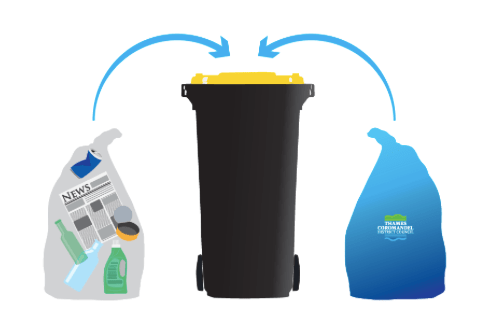
THE FORTNIGHTLY COLLECTION WILL BE ON YOUR NORMAL RECYCLING DAY IN YOUR NORMAL RECYCLING WEEK.
**FOR OPOUTERE THIS WILL START ON OUR NORMAL “WEEK 1” CYCLE, MEANING OUR BINS WILL BE EMPTIED EVERY FORTNIGHT STARTING MONDAY APRIL 6. TCDC has stated we will not get a collection on Monday March 30.
- ALL household rubbish goes into a blue bag as normal (don’t worry if you run out, any tied bag is ok) but this goes IN the wheelie bin.
- Recycling goes into a separate plastic bag (any bag is ok) and this also goes IN the wheelie bin.
- Transfer stations and compactors are still operating
- Check out the council’s dedicated page for changes to kerbside collections where there is a great deal of useful information.
Water delivery available
In addition to the offer of firewood for anyone who is in need Jo Adams is also able to arrange for water to be delivered if your tanks are running low.
Please call Jo on 0274 493 034. (Thanks Jo, this is amazing).
Community Support
As the weeks go by we will all need some help, please don’t hesitate to leave a message HERE. This is totally confidential and someone will get in touch within the day to chat about what you need.
Keep an eye on neighbours, and take care of yourself and your family.
Thriving in Isolation in Opoutere

He waka eke noa.
We are all in this together.
At the moment things are pretty unsettled and unsettling. We are all facing uncertainty about so many things – our health, our financial security, perhaps our family situations. It is normal to feel anxious and a bit out of sorts, these are unprecedented events in our lives.
In times of sudden change it’s good to start with the basics. If you want to understand more about COVID-19/Coronavirus the best website to visit is the official New Zealand Government page: https://covid19.govt.nz. It has simple explanations of the alert level system and what this means for us all. It explains how to keep yourself safe and how to ask for help (financial, medical, social).
From 11.59pm Wednesday 25 March our country goes to COVID-19 Alert Level 4.
This is when our lives really change for a while and when we need to step up as friends, neighbours and community members.
How We Can Stay Safe in Opoutere
We are very lucky to be in a quiet corner of the world at the moment, so let’s help each other to stay well and happy through the coming months.
It is important to follow the official advice on public health and social measures that need to be taken to contain the spread of the disease.
- Stay home
- Maintain 2 metre social distancing, everything you do must be solitary. The bottom line is that the government are asking us to only spend time with people we are self-isolating with, keep your distance from all others at all times. A walk or bike ride is encouraged but you need to maintain that 2m distance from people who are not in your immediate family group.
- Check in on the elderly and vulnerable. Make regular phone calls, say hello over the fence (2m distance), offer to collect groceries or medication.
- Keep yourself healthy with frequent hand washing and appropriate hygiene routines.
The Ministry of Health has a great website with useful links to information about the disease itself, prevention and what to do if you have been exposed.
Importantly, here is the Healthline number 0800 358 5453. This is a free, 24hr service that provides advice and information for any Covid-19 concerns you may have.
Another source of good information is the World Health Organisation https://www.who.int/emergencies/diseases/novel-coronavirus-2019
Official advice for mental wellbeing
From the NZ government website:
“Reach out to your usual supports – family and whānau, friends and workmates. Sharing how we feel and offering support to others is important.
We also recommend sticking to a routine such as having regular mealtimes, bedtimes and exercising.
If you feel you are not coping, it is important to talk with a health professional. For support with grief, anxiety, distress or mental wellbeing, you can call or text 1737 – free, anytime, 24 hours a day, 7 days a week – to talk with a trained counsellor.
Spend time in places that feel safe and comfortable as much as possible.
Tell yourself that how you are feeling is a normal reaction and will pass – it’s nothing to be afraid of.
Keep active – doing usual leisure activities and seeing friends can improve general wellbeing and help distract from distressing feelings.”
Some Local Initiatives
Jo Adams, the Onemana Rural Fireforce Chief, has been busy working the phones and lining up some really helpful resources for the Opoutere community. We are very grateful for his advocacy and practical planning on our behalf.
Thank you, Jo!
Food Shopping
Supermarkets are an “essential business” and will be remaining open. There’s no panic around food and household supplies!
The New World supermarket in Whangamata have been contacted by Jo and have proposed a grocery delivery service to customers in Opoutere. This will help reduce pressure on the supermarket staff who will be enforcing a one-in-one-out rule and will reduce the risk of infection for everyone. The plan involves ordering online as you normally would and the team will get the groceries out to Opoutere. It is important to prevent any contact with delivery staff – so stay indoors and wave gratefully when the goodies arrive!
Follow this link to the New World online shopping page.
We will let you know if any of these details change. Thank you, Neville and the team at Whangamata!
Firewood
With the cooperation of local forestry Jo is sourcing some large pine trees to be split up and distributed to anyone in need. We will let you know how to access this wood once it has been split and stockpiled. If you can help with the wood processing please give Jo a call on 027 449 3034.
Fire and Emergency Teams
Jo is carefully managing his volunteer fire-fighting teams to keep them safe and able to respond as they normally would to any fire or first aid emergencies.
If you would like to be involved with the Onemana Voluntary Rural Fire Force give Jo a call on 027 449 3034.
Share Your Garden’s Bounty!
If you’ve got some extra fruit or vegetables that you can’t eat please think about popping a notice on the bus shelter noticeboard with your phone number. (You might get a jar of preserves or marmalade in return.)
Want to get in touch?
There’s a notice on the bus shelter that you can write your number on if you need ANYTHING. Or you can leave us a message HERE and we will email you back within the day.
Take care, everyone.
It Has Actually Rained!

After what seems like months of dry weather Opoutere has finally had a few hours of solid rain. The air is clear and the whole place has been washed clean. Hallelujah!
No doubt you have all been out to thump the side of your water tanks and are relishing the thought of that wonderful fresh rain in there. However, we need to keep up the rain dances as we are still in an extreme fire risk situation. Sorry, to be a downer!
Yay for rain, pray for more.
Opoutere Celebrates the Dotterel Season
Opoutere Community
BBQ Invitation
To Celebrate with DOC: another successful breeding season of the
NZ Dotterel, Variable Oyster Catcher and Caspian Tern

February 29th 2020
Saturday
1pm
at Wharekawa Lodge
389 Opoutere Road
BYO to share: salad /contribution to BBQ
organized by:
Opoutere DOC volunteers and Wharekawa Outdoor Education Trust
Here’s an update from the 2019/2020 dotterel breeding season. (With special thanks to Dave Burbage for circulating this great news to the community):
the wildlife refuge. The last nest at Ohui was predated by stoats.
last season. All going well there could be 17+ fledged chicks this season.
10 Oyster catcher chicks fledged.
There are 2 Variable Oyster catcher chicks on the refuge.
There is 1 Caspain Tern chick and is fledged
They are low in numbers with approximately only 1300-1400 breeding pairs.
Thank you to Opoutere community for your support. Well done!
Towards a Community Collective Commitment
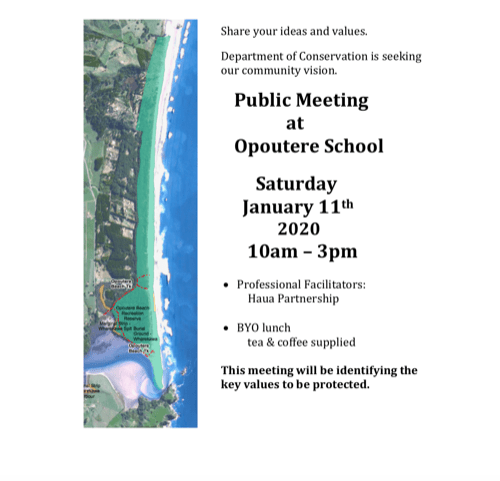
Community Collective Commitment meeting January 11th for the Opoutere Beach Reserve
We would like to provide information to members about the CCC.
- The January 11th community meeting will be the chance for all members of the Opoutere Community to share their vision and values for the Opoutere Beach Reserve, administered by DOC. Note: This day is only focusing on the Opoutere beach reserve, not other DOC administered land around Opoutere.
- ORRA is inviting members to attend this meeting and be part of identifying what they personally value about the Opoutere Beach Reserve. Only those present on the day will have their views heard. There are no written submissions. All members are urged to consider your values and your vision for the Reserve, prior to this meeting.
Please take some time to read the following helpful documents as you are thinking about your values and vision.
- A longer statement, backgrounding some of the reasons for and aims of the Community Collective Agreement. We had been asked by some ORRA members to supply this background information.Towards a CCC – message 20191218
- These are ORRA’s values, as at December 2019, as part of our ORRA constitution.ORRA Values Dec 2019
ORRA AGM January 2nd 2020 :
Please read all documents prior to our AGM. There will be time to discuss, ask questions, queries and raise concerns (if any).
The committee is looking forward to seeing as many as possible at the ORRA AGM on January 2nd, 2020.
We hope you have all had a lovely Christmas, please stay safe on the roads and the beaches!
An Important Public Health Warning
Marine biotoxin warning issued
The Ministry for Primary Industries (MPI) today issued a public health warning advising the public not to collect or consume shellfish harvested from the southern end of Pauanui Beach down to the northern tip of Mount Maunganui, including the Tauranga Harbour.
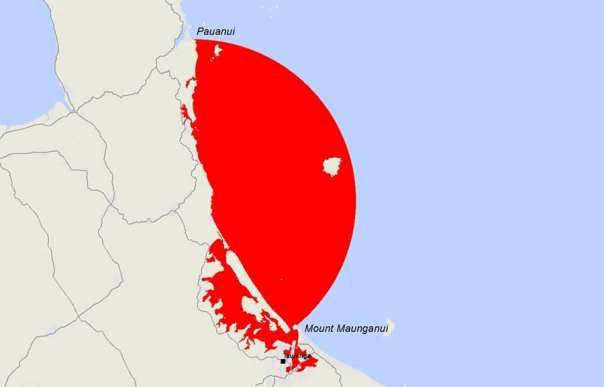
Routine tests on shellfish samples taken from this region have shown levels of paralytic shellfish poisoning (PSP) toxins above the safe limit of 0.8 mg/kg set by MPI. Anyone eating shellfish from this area is potentially at risk of illness. Please help keep your whānau safe over the Christmas break and avoid collecting shellfish from the affected area.
Due to currents and prevailing winds going in the opposite direction, the presence of toxic shellfish are not believed to be related to the recent eruption of White Island.
Mussels, oysters, tuatua, pipi, toheroa, cockles, scallops, catseyes, kina (sea urchin), and all other bivalve shellfish should not be eaten.
Note: cooking shellfish does not remove the toxin.
Pāua, crab, and crayfish may still be eaten if the gut has been completely removed prior to cooking, as toxins accumulate in the gut. If the gut is not removed its contents could contaminate the meat during the cooking process.
Symptoms typically appear between 10 minutes and 3 hours after ingestion and may include:
- numbness and a tingling (prickly feeling) around the mouth, face, and extremities (hands and feet)
- difficulty swallowing or breathing
- dizziness
- headache
- nausea
- vomiting
- diarrhoea
- paralysis and respiratory failure and, in severe cases, death.
If anyone becomes ill after eating shellfish from an area where a public health warning has been issued, phone Healthline for advice on 0800 61 11 16, or seek medical attention immediately. You are also advised to contact your nearest public health unit and keep any leftover shellfish in case it can be tested.
Monitoring of toxin levels will continue.
Commercially harvested shellfish – sold in shops and supermarkets, or exported – is subject to strict water and flesh monitoring programmes by MPI to ensure they are safe to eat.
The Latest from ORRA


It’s been a busy year for ORRA. We thought it was about time for an update!
Acting Chair
Earlier in the year, Gordon Ikin, our elected chairperson, had to step down for health reasons. Committee member Val Herbert, kindly and valiantly stepped up to be our acting chair. Val has done an incredible job of heading the association through some interesting times . . .
Containers of herbicide found on the beach reserve
During the winter some containers of herbicide, tagged with ORRA’s name, were found on the beach reserve. Did they belong to ORRA? No, they didn’t and the person responsible has apologized for this. The upside is: this resulted in discussions with DOC about the need for a Community Agreement to define permitted activities around weed and pest control. This is now in train. We hope this Community Agreement will be in place soon as this is essential for our ongoing work on public land. Especially because . . .
We got some serious funding
We are thrilled that ORRA has been awarded $14,080 from DOC’s Community Fund – Pūtea Tautiaki Hapori. The Fund was oversubscribed with a total of 378 applications with $8 million available – so we are especially grateful that DOC has recognised us with this grant.
Covering three years the grant provides for resetting predator traps (Goodnature), non-toxic lures for our DOC 200 predator traps, equipment to keep our volunteers safe and tools to monitor predator numbers in the area. The funding panel acknowledged the good work done by ORRA in the past and together we’re busy finalising the details so we can get back to the mahi.
Tea Towels
Doing the dishes never looked so good! A whopping $3,510 has been raised from the first tea towel print run featuring the fabulous native creatures of Opoutere. They are now sold out. There may be another print run pre-Christmas, conditional on demand. Please put your Christmas pre-orders in ASAP to Rachel Lang. rachelamlang@gmail.com
Youth Hostel Reopens
It’s BACK! After a sad eighteen months the Opoutere YHA is reopening under a new entity – Wharekawa Adventure Education Trust, and will offer summer accommodation from early December 2019. If you are a YHA member you’ll get preferential booking, for more information go to http://www.yha.co.nz.
Bruce’s Bay
Hard-working volunteers transformed the Bruce’s Bay causeway and foot-bridge (you can’t miss the cheerful yellow paint job!). The whole area has been battered by high tides and further work will happen as time allows. Thanks to all the workers, but especially to project leaders: Peter Le Heron, Keryn Kliskey and Stuart Farmer.
Tree poisoner rumours
This continues to be a focus in the community, so we thought we should talk about it. An individual has been accused. They have said to ORRA, also to DOC, that they have not done this. We believe them. There is no evidence to suggest that they are responsible. Community rumour has resulted in unfortunate vigilante action and appalling vandalism. It has got so bad that the police have been notified.
ORRA asks that everyone in our community remember our values: respect, tolerance and kindness. If you have concerns; let’s talk before resorting to threatening tactics.
Forestry report
Logging and more frequent flooding mean that more silt is accumulating in the estuary. ORRA has commissioned a report from an independent forestry expert to give us an overview of local forestry. This work is ongoing, and extremely important – the health of our estuary affects us all.
Mangroves
Mangroves are great in the right place. But increasing siltation means they are growing out of control. We continue to cut them back, but we have to work within a resource consent from the Waikato Regional Council. In the recent renewal of the consent we weren’t able to get the conditions varied to include using line trimmers. We’ll be doing more working bees on mangroves next year – and thanks to committee member Lene Knight for carrying the flame on this.
Defibrillator/AED
Opoutere now has a defibrillator, it is located at 301 Opoutere Rd (Elizabeth Savage’s house). When in use it has pre-recorded instructions that guide the user. Thanks to the Onemana Voluntary Rural Fire Force for donating the defibrillator which was surplus to their needs, and to committee member Neil Graham for installing it.
Dog Control
As you may have seen, we have new signs about dogs on the beach. Dogs are not permitted anywhere south of the yellow benches or off-lead on any other part of the beach. This is particularly important now the dotterels are busy breeding! The good news is, we have a new TCDC dog control officer in Whangamata. Rebecca Tilsley is making effective efforts to control dogs and she also oversees freedom camping compliance. She will respond to any complaints and does regular patrols, you can call TCDC day or night on 07 868 0200.
Dotterel Ranger
Keep an eye out for the new Dotterel Ranger, Stewart, who has started patrolling the beach and dunes to keep an eye on the dotterels. They are nesting right along the beach this season, probably due to the changed terrain on the spit. Dogs, especially, should be kept well away from nesting sites. Please make sure to give our small neighbours plenty of space so they can get on with raising their families in peace.
CCC – the Community Collective Commitment
You may have seen the notices about the Community Collective Commitment that is proposed for Opoutere. This process will define the combined values of the community – which will influence policy and future funding. It is important and affects all of us. The CCC is a collaborative effort that involves ORRA, the Wharekawa Catchment Care Group and independent locals who wish to be heard. DOC is facilitating the process. There will be a public meeting to discuss this on 11 January 2020. Notices confirming details will be posted in the village and emailed out where possible.
Please have a think about what matters to you in Opoutere and have your say. You can email our interim chairperson Val Herbert at tvherberttv@gmail.com with any concerns or questions.
AGM
Come along to the ORRA AGM, Thursday January 2, 2020, time TBC, Opoutere School Hall. Notices will be emailed out and posted in the village.
Regatta
The legendary Opoutere Regatta will be held on Friday January 3rd in Bruce’s Bay. Look out for notices about the time. Rain day 4th January. Everyone is welcome to attend and participate, from the littlest toddler to the most competitive bloke with a score to settle from regattas past (you know who you are). There’ll be a prize-giving BBQ on the reserve afterwards, undignified lolly scramble included.
ORRA
http://www.opoutere.org.nz| tvherberttv@gmail.com
Exciting Youth Hostel News

Media Release 16 October 2019
YHA ANNOUNCE SUMMER ACCOMMODATION IN OPOUTERE By YHA New Zealand
YHA New Zealand are delighted to announce the handover of the former YHA Opoutere to the Wharekawa Adventure Education Trust which will include summer accommodation offerings.
The Opoutere hostel shut its doors in April 2018 following winter closures and low occupancy over a number of years. YHA New Zealand has been working with a local group, now formalised as the Wharekawa Adventure Education Trust (WAET), since early 2018 to facilitate handover of the property to deliver outdoor education programmes for youth. With the formalisation of the Trustnow complete, YHA are able to announce the Trust’s intention to also provide visitor accommodation over the peak summer period.
Mark Wells, YHA New Zealand’s Chief Executive, is particularly pleased to see the development go public. “We have worked together for many months to realise the vision of Wharekawa, with strongsupport from the Thames Coromandel District Council. We are especially supportive of this initiative, which aligns directly with the gazetted purpose of the site to deliver programmes for the benefit of youth.”
“YHA Opoutere was a very special location for many of our members, guests and staff over theyears. To find a group so passionate about supporting youth development in line with our own mission and values, and who are able to offer that summer accommodation, was an excellentoutcome for all parties,” says Mr Wells. “We know several families who loved the site as they woulda family bach, so this development will be great news for them.”
In support of this development, Wharekawa Adventure Education Trust has entered into a new lease with the Thames Coromandel District Council who own the land, and purchased the improvements on site from YHA. They plan to offer visitor accommodation from December 1 2019, with outdoor education programmes commencing in early 2020.
“We’re really excited about the future and the programmes we can offer,” says spokesperson forWAET, Alistair Luke. “We’ve really appreciated the work YHA have put in to help us bring this dream to life. We can’t wait to get started.”
The Thames Coromandel District Council is similarly delighted with the result. “The gazetted purposeof the site has always been to deliver programmes for the benefit of youth,” says Council representative Jon Muston. “The intended use of this site demonstrates a really excellent alignment with this purpose and we’re very appreciative of the collaboration between YHA New Zealand andWharekawa Adventure Education Trust to make this happen.”
WAET are finalising their booking system and intend to offer bookings to YHA members before opening these to the public. Booking information is expected to be provided to YHA members in early November.
About YHA New Zealand
The Youth Hostels Association of New Zealand (YHA New Zealand) is a not-for-profit association established in 1932 in Canterbury. With a network of over 35 hostels in both islands, YHA New Zealand provides high quality budget accommodation to New Zealanders and international travellers. YHA New Zealand is a committed advocate of sustainable practices. For more information, please visit: http://www.yha.co.nz.
To learn more about this please contact:
Mark Wells
Chief Executive, YHA New Zealand 166 Moorhouse Ave, Christchurch DDI: 03 353 9197
MOB: 027 494 7560mark.wells@yha.co.nz
 The View From Opoutere